


Manual Testing vs Automation Testing: Why Bad Test Automation Is the Real Problem

Published on March 23, 2026
The Wrong Debate in Software Testing
If you’ve spent any time in engineering discussions, you’ve probably heard it framed this way: Manual testing vs. automation testing.
One is slow but thoughtful. The other is fast but scalable. And the assumption is clear - Automation wins. But that’s not what’s actually happening inside most engineering teams.
Teams invest heavily in test automation, adopt modern tools, and integrate with CI/CD pipelines. Yet, they still struggle with flaky tests, slow pipelines, and constant maintenance. Releases get delayed, and confidence in testing drops.
Even with widespread adoption, where nearly half of teams have automated most of their testing, over 50% of developers still deal with flaky tests, and more than half of CI failures are caused by them.
So the problem isn’t manual testing. The real problem is bad test automation. And until teams fix that, no amount of automation will improve software quality.
Why Human Involvement Still Plays a Critical Role
Despite what many assume, manual testing remains highly relevant.
Manual testing shines where automation struggles. Think exploratory testing, edge cases, and real-world user behavior. A human tester can navigate a product like an actual user, question assumptions, and catch issues that no script would think to test.
This is especially important in early-stage products, complex workflows, and UX-heavy applications.
Automation doesn’t decide what matters. Humans do. In fact, the best test automation strategies are built on insights from manual testing. Without that foundation, automation often ends up testing the wrong things efficiently but incorrectly.
The Real Problem is Bad Test Automation
Here’s where things start to break down.
Most teams don’t fail because they avoid automation. They fail because they implemented it poorly.
Bad automation usually looks like this:

Over time, this creates a system where:
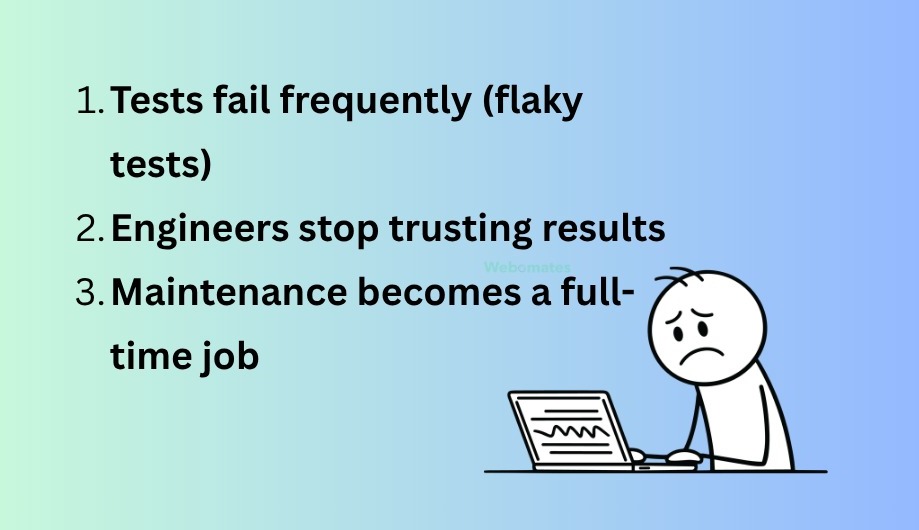
Instead of speeding things up, automation becomes a drag on delivery. This is one of the biggest challenges in automation testing today.
Signs Your Test Automation Strategy Is Failing
You don’t need a deep audit to know when automation isn’t working. When flaky tests make up nearly 15% of failures and even cause over half of CI build breaks in some teams, the symptoms show up everywhere.
Your test automation framework might be struggling if:
- Test suites take too long to run in your CI/CD pipelines
- Failures are frequent but not always meaningful
- Small UI changes break large portions of your tests
- Your team spends more time fixing tests than writing new ones
Another big red flag is when your automation doesn’t align with business priorities. If your tests cover edge cases but miss critical user flows like checkout, onboarding, or payments, your software testing strategy isn’t delivering value.
What Good Test Automation Actually Looks Like
Good is not about quantity. It’s about impact.
High-performing teams focus on:
- automating critical user journeys
- ensuring fast feedback through continuous testing
- integrating tightly with CI/CD testing workflows
They also understand that not everything should be automated.
Manual testing is used for exploration and discovery. Automation is used for scale and consistency. Most importantly, good automation is maintainable. It evolves with the product without constant rework. That’s what makes it truly scalable test automation.
How AI Is Fixing Broken Automation
This is where things get interesting.
A lot of the problems with traditional automation maintenance, fragility, and slow updates are exactly what AI test automation is designed to solve.
Modern AI-driven testing systems can:
- Generate test cases automatically
- Identify high-risk areas in the application.
- Suggest coverage improvements
- Adapt tests when the UI changes
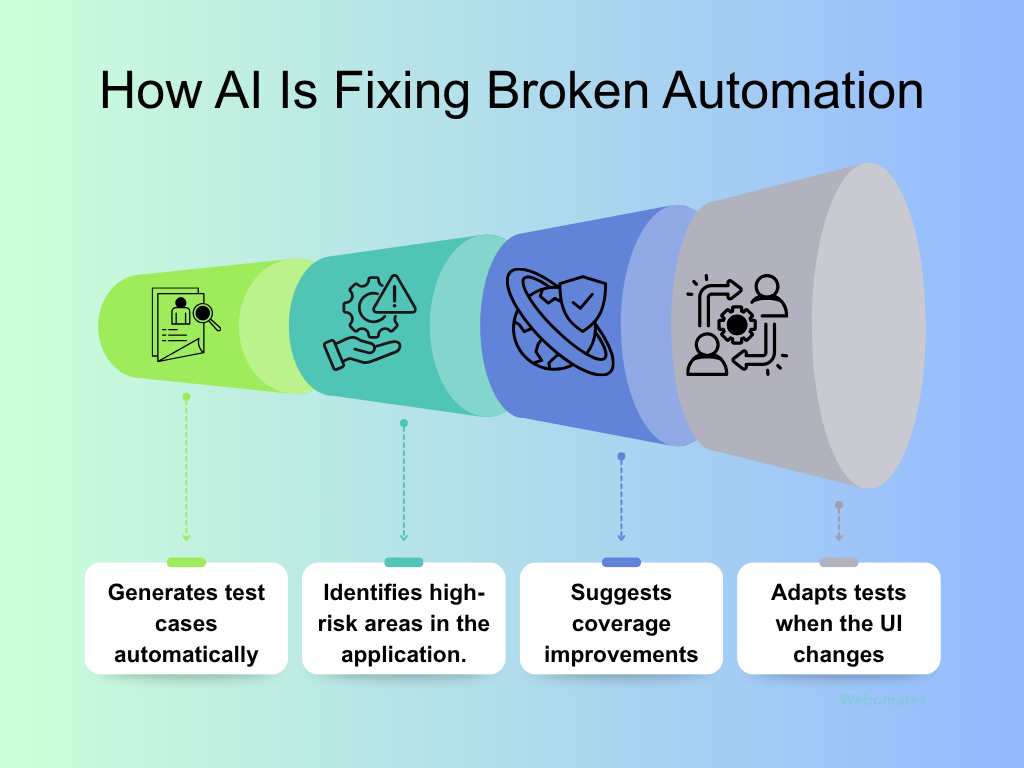
One of the biggest breakthroughs is self-healing automation.
Instead of breaking when a button ID changes or a layout shifts, AI systems can detect the change and update the test automatically. That means fewer broken tests and less manual intervention.
This changes the equation completely. Instead of spending time maintaining scripts, teams can focus on improving test coverage and product quality.
What This Means for Modern QA Teams
As automation evolves, the role of QA teams is changing too.
The focus is shifting from:
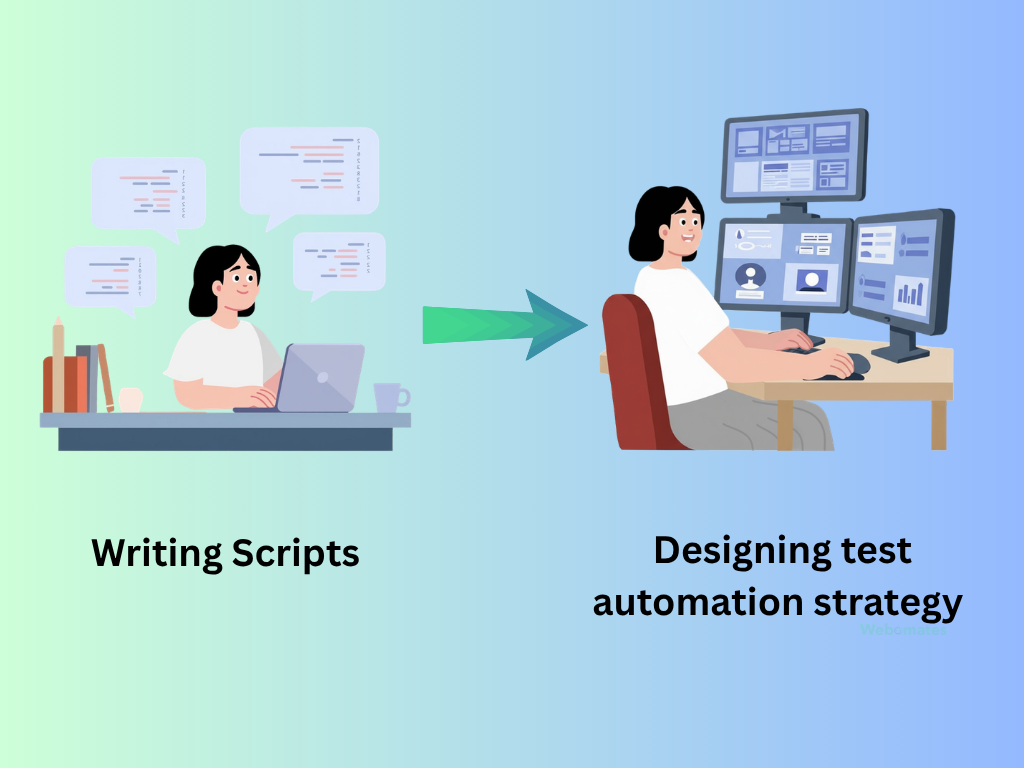
Teams are spending less time on repetitive tasks and more time on identifying risk, improving coverage, aligning testing with business goals, eventually leading to faster release cycles, higher confidence in deployments, and better overall software quality.
For teams trying to scale without increasing headcount, this shift is critical.
The Shift from Manual vs Automation to Smart Automation
At this point, the manual testing vs. automation testing debate feels outdated.
The real question is not whether to automate. It’s how intelligently you automate.
Teams that rely on traditional, brittle frameworks will continue to struggle with maintenance and scalability. But teams that adopt smarter approaches, especially those using AI in software testing, can move faster and with more confidence.
This is the direction the industry is heading.
Conclusion
As testing complexity grows, engineering teams need ways to expand test automation coverage without increasing the effort required to create and maintain tests.
Platforms like Webo.ai are designed to make this possible.
With Webo.ai, AI automatically generates test strategies, test cases, and automation workflows. Teams can review the output, accept it, suggest changes, or request different coverage based on their needs.
Once ready, automation can be executed across environments, while AI healing keeps tests up to date as the application evolves. This removes one of the biggest challenges in automation: constant test maintenance after every UI change.
Instead of fixing broken tests, teams can focus on improving coverage and delivering quality at scale.
Webo.AI (Webomates) makes sure that each line of test automation is thoroughly inspected and verified from the very beginning of development to the product’s release. Teams trust Webo.AI to get enterprise-grade test automation coverage, without adding any additional infrastructure, resources, or tools.
Get enterprise-grade test automation coverage without the overhead. Start a free trial with Webo.AI and streamline test automation with AI—speed, coverage, and confidence for small teams.
Ready to Streamline Test Automation for Your Small Team?
AI-powered test automation without the maintenance burden. Webo.AI helps small teams accelerate releases, reduce script maintenance, and boost quality—try it free.
Start Free TrialPlease click here and schedule a demo, or reach out to us at [email protected].
FAQs
1. What is the difference between manual testing and automation testing?
Manual testing involves human testers executing test cases without scripts, making it ideal for exploratory testing and user experience validation. Automation testing uses tools and scripts to run tests repeatedly, making it faster and more scalable. The real challenge isn’t choosing between manual testing and automation testing, but ensuring automation is implemented effectively.
2. Why do most test automation projects fail?
Most test automation projects fail due to poor implementation rather than a lack of tools. Common test automation challenges include flaky tests, high maintenance costs, weak test coverage, and slow CI/CD pipelines. When automation is not aligned with business goals, it creates more problems than it solves.
3. What are flaky tests, and how do they impact CI/CD pipelines?
Flaky tests are inconsistent tests that pass or fail without code changes. They are a major issue in CI/CD testing because they reduce trust in test results, cause false failures, and slow down release cycles. In many teams, flaky tests are responsible for a large percentage of CI pipeline failures.
4. When should you use manual testing instead of automation testing?
Manual testing is best used for exploratory testing, usability testing, and complex scenarios involving human judgment. Automation testing should focus on repetitive tasks and critical user flows. A balanced software testing strategy combines both approaches instead of relying entirely on automation.
5. How does AI test automation improve software testing efficiency?
AI test automation improves efficiency by generating test cases, identifying high-risk areas, and enabling self-healing tests that adapt to UI changes. This reduces maintenance effort, minimizes flaky tests, and improves CI/CD pipeline stability. As a result, teams can scale test automation without increasing workload.