


Published on February 09, 2026
How to Measure QA Effectiveness in Startups in 2026

In 2026, startups are shipping faster than ever with leaner teams, AI-assisted development, and increasingly complex products. Yet many founders and CTOs still struggle to answer a deceptively simple question:
Are we actually measuring QA effectiveness in our startup, or just tracking testing activity?
Bug counts, test case numbers, and pass rates might look reassuring. But they rarely reveal whether your quality system is protecting revenue, accelerating delivery, or quietly building risk. To truly measure QA effectiveness in startups, leaders must move beyond operational metrics and adopt QA key performance indicators for startups that expose business impact.
This article outlines the most important QA effectiveness metrics for startups in 2026 and how modern teams use them to reduce release risk, control the cost of poor quality, and scale without sacrificing stability.
Why Startup QA Metrics Must Change in 2026
Startups in 2026 operate under conditions that traditional QA models were never designed for. Smaller engineering teams are now responsible for increasingly complex systems, releases happen weekly or continuously, AI is accelerating both development speed and defect propagation, and customers expect enterprise-grade reliability even from early-stage products.
In this environment, startup QA KPIs are no longer internal performance reports. They are leading indicators of business health.
Leadership teams now depend on QA metrics to answer critical questions:
- Are releases getting safer or riskier?
- Is automation reducing cost or increasing maintenance drag?
- Is quality helping us grow or slowing us down?
This shift requires reframing how QA effectiveness metrics for startups are defined and interpreted.
From Testing Output to Business Outcomes
Many teams still measure QA success by what is easiest to count: Number of test cases, Test execution time, and pass/fail percentages. These metrics describe effort, not effectiveness. In contrast, modern startup QA performance indicators to track in 2026 focus on outcomes: Release confidence, Customer impact, Engineering focus, and Cost of poor quality.
When leaders evaluate QA through this lens, quality stops being a cost center and becomes a growth control system.
The 2026 QA Effectiveness Dashboard for Startups
To measure QA effectiveness in a startup environment, leadership teams should organize metrics into three executive-level categories.
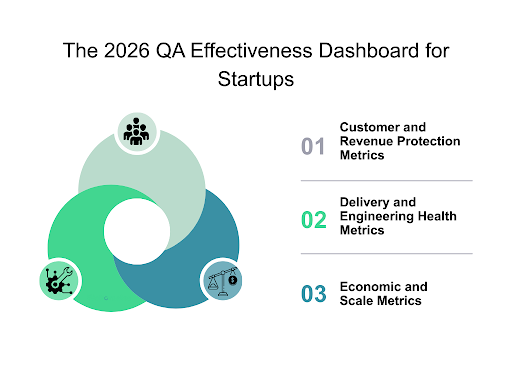
1. Customer and Revenue Protection Metrics
These metrics show how quality impacts customer experience, retention, and revenue.
- Escaped defects reaching users
- Quality-related churn signals
- Feature adoption blocked by instability
- Incident frequency after releases
These are the most important QA metrics for SaaS startups because they directly reflect trust erosion.
If these numbers rise, QA is not underperforming; your growth engine is leaking.
2. Delivery and Engineering Health Metrics
These QA KPIs matter most for small development teams operating under speed pressure.
- Release confidence index (pre-release risk vs post-release reality)
- Regression exposure rate
- Mean time to detect quality failures
- Automation reliability ratio
These startup QA KPIs and metrics for 2026 reveal whether quality systems are stabilizing delivery or creating false confidence. Stable pass rates with rising escaped defects usually indicate blind spots, not progress.
3. Economic and Scale Metrics
These indicators measure the impact of QA metrics on startup success from a cost and scalability perspective.
- Cost of quality per release
- Automation leverage ratio
- Defect rework engineering hours
- Maintenance overhead vs coverage gained
These metrics expose how QA metrics reduce the cost of poor quality in startups, or allow it to compound unnoticed. If QA cost grows faster than product velocity, effectiveness is declining.
How Leaders Should Interpret Startup QA KPIs
Metrics only matter when they trigger decisions. Leadership teams should read QA key performance indicators for startups through a cause-and-effect lens.
When escaped defects increase, customer trust erodes, and churn risk rises; when automation grows, but coverage stagnates, maintenance drag increases; and when release frequency rises while confidence drops, it signals declining QA maturity.
This framing turns startup QA KPIs into early warning systems instead of historical reports.
Why AI Changes How QA Effectiveness Is Measured
AI is not only changing how testing is performed, but it’s also changing how QA effectiveness metrics for startups must be evaluated.
In 2026, leaders track AI-driven QA metrics for modern startups, such as self-healing automation success rates, predictive defect concentration patterns, test maintenance cost per sprint, and automation resilience during rapid product changes. AI increases speed. Without modern metrics, it also increases failure velocity.
The new leadership question becomes: Is AI compressing QA effort or amplifying fragile systems?
What High-Performing Startup Teams Do Differently
Startups that measure QA effectiveness well consistently treat QA metrics as part of executive dashboards, tie quality indicators directly to growth planning, measure QA systems rather than isolated QA output, and invest where risk is highest rather than where coverage is easiest. They use quality data to anticipate operational friction before it shows up in revenue or retention. Over time, this discipline turns QA from a support function into a strategic control system for scale.
They don’t ask how many tests were run. They ask whether quality is protecting momentum.
QA Effectiveness Is a Leadership Metric Now
In 2026, startups won’t fail because they lack testing effort. They’ll fail because they misread quality signals.
The startups that win in 2026 will be the ones that track startup QA KPIs that surface risk early, use QA effectiveness metrics to actively protect revenue, leverage AI without surrendering reliability, and reduce the cost of poor quality before it compounds into delivery drag and customer churn. If you can’t explain how your QA metrics protect growth, you’re not measuring effectiveness; you’re reporting activity.
Webo.ai helps startups modernize their QA systems with AI-driven automation and leadership-grade quality insights, so every release is faster, safer, and economically scalable.
See your QA effectiveness metrics in action. Start a free trial with Webo.AI and get leadership-grade dashboards without the guesswork.
Ready to Transform Your QA Effectiveness?
Unlock leadership-grade QA dashboards for your startup. Experience rapid launches, better reliability, and actionable insights with Webo.AI.
Start Free TrialFAQs
1. What does QA effectiveness mean for startups in 2026?
QA effectiveness in startups in 2026 measures whether quality systems protect revenue, reduce release risk, and support fast growth. It goes beyond counting test cases or bugs and focuses on business outcomes. Effective QA metrics reveal risk early and prevent customer impact. For startup leaders, QA effectiveness is a growth safeguard, not an activity report.
2. Why are traditional QA metrics not enough for startups?
Traditional QA metrics like pass rates and test counts measure effort, not impact. In fast-moving startups, these metrics can hide growing release risk and customer-facing defects. Modern startup QA KPIs focus on escaped defects, release confidence, and cost of poor quality. This shift ensures quality metrics reflect real business health.
3. What are the most important QA KPIs for startups to track in 2026?
The most important QA KPIs for startups include escaped defects, quality-related churn signals, release confidence, automation reliability, and cost of quality per release. These metrics show whether QA is stabilizing delivery or introducing hidden risk. They also help leaders understand how quality affects revenue and scalability. Together, they form an executive-level QA effectiveness dashboard.
4. How should startup leaders interpret QA effectiveness metrics?
Startup leaders should interpret QA metrics through cause-and-effect relationships, not isolated numbers. Rising escaped defects signal increasing churn risk, while growing automation with stagnant coverage indicates maintenance drag. When release speed increases but confidence drops, QA maturity is declining. This approach turns QA KPIs into early warning systems.
5. How does AI change how QA effectiveness is measured in startups?
AI changes QA effectiveness measurement by increasing both speed and potential failure velocity. In 2026, startups track AI-driven QA metrics like self-healing success rates, predictive defect patterns, and test maintenance cost per sprint. These metrics reveal whether AI reduces effort or amplifies fragile systems. Measuring AI impact correctly is essential for sustainable scale.