


AI Test Automation: The Next QA Stack Where Humans Design and AI Executes
Published on March 9, 2026
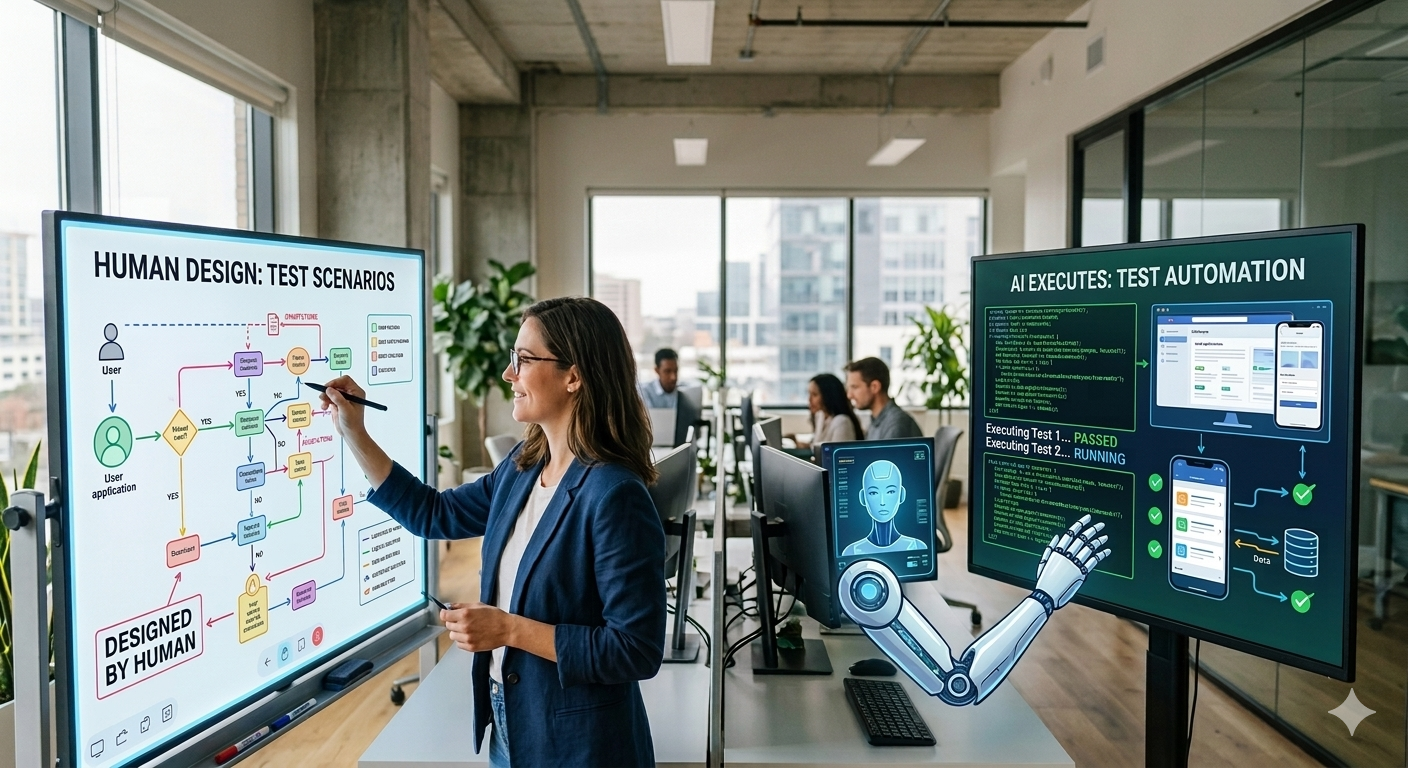
Software delivery is moving faster than ever. Engineering teams are releasing features quickly using CI/CD pipelines, microservices, and continuous deployment. According to the Capgemini World Quality Report, more organizations are investing in AI-driven testing and intelligent automation to keep up with this rapid pace.
However, as automation spreads throughout the development process, organizations are finding that fully automated systems often fall short. Studies on human-in-the-loop automation show that combining AI with human oversight can achieve 96-98% accuracy, surpassing both manual and fully automated approaches.
The reason is straightforward. AI can handle tasks at scale, but humans add context, judgment, and help set priorities. In software testing, this teamwork often makes the difference in catching important defects before release.
Put simply: “Humans design. AI executes.”
This change is reshaping the future of QA, AI test automation, and software quality engineering.
Why the Traditional QA Stack Is Breaking Down
For years, the typical testing workflow looked like this:
-
Developers ship features
⇓
-
QA engineers write test cases.
⇓
-
Automation engineers convert them into scripts.
⇓
- Teams maintain those scripts across releases.
While this idea should help build scalable test automation frameworks, it often leads to challenges in practice.
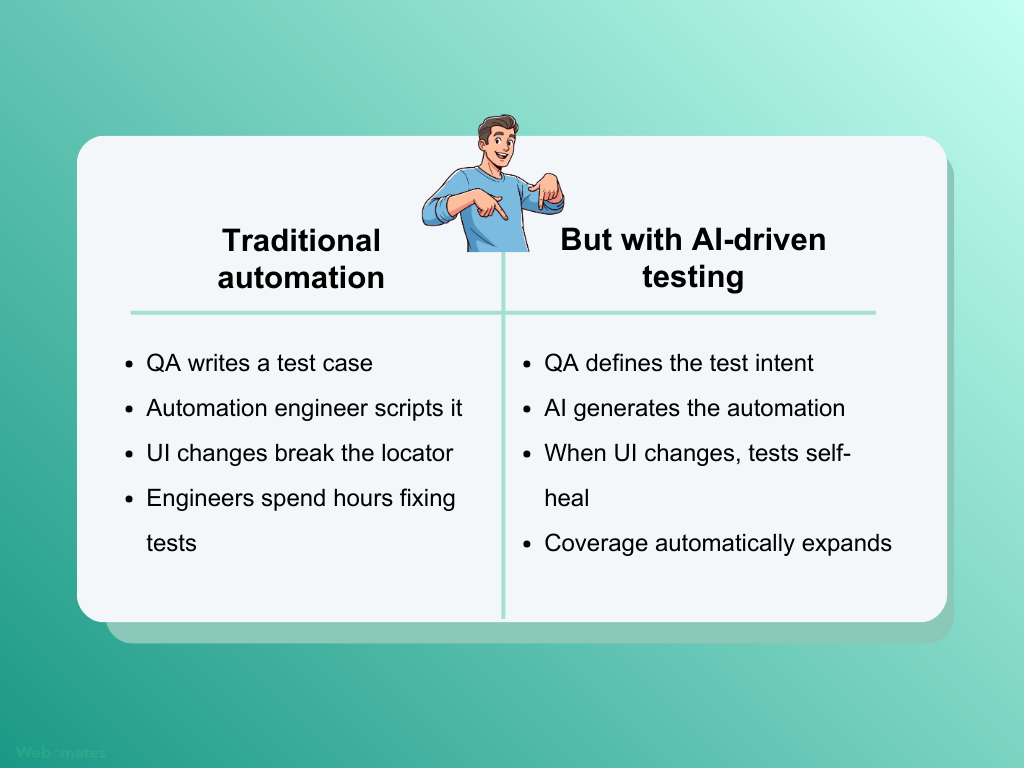
As applications become more complex, maintaining test automation becomes more difficult. UI changes can break locators, and product updates may disrupt existing flows. Over time, automation suites often slow down and become less reliable.
Many organizations now spend more effort maintaining automation than creating new coverage. This is one reason the World Quality Report consistently highlights automation, maintenance, and scalability as key testing challenges.
This leads to a cycle that many engineering teams know well:
- Automation suites start to become unstable
- Teams lose trust in test results
- Manual validation increases
- Delivery speed reduces
The promise of AI in software testing is not just faster automation. It is the ability to fundamentally change how automation is created and maintained.
Why AI Test Automation Is a Natural Evolution
The shift toward AI-driven testing is not happening in isolation. It is being driven by broader engineering trends.
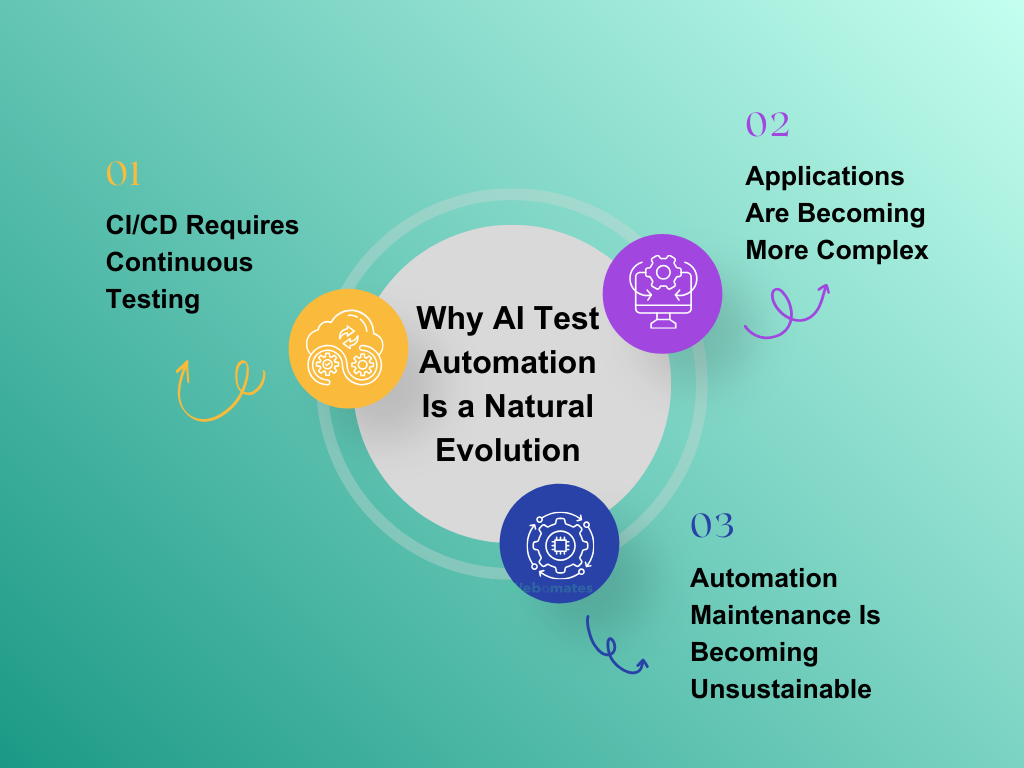
1. CI/CD Requires Continuous Testing
Today’s engineering teams use CI/CD pipelines to quickly release code. However, continuous delivery is only effective if testing can keep up. AI-powered automation runs tests automatically across builds, environments, and releases, reducing the need for manual work.
Because of this, AI test automation fits well into today’s DevOps pipelines.
2. Applications Are Becoming More Complex
Complex software products rarely live in a single environment. Applications now span:
- Web platforms
- Mobile applications
- APIs and microservices
- Cloud infrastructure
Maintaining scalable test automation across these layers is difficult using purely manual automation engineering.
AI systems can analyze application behavior across layers, helping teams scale testing more effectively.
3. Automation Maintenance Is Becoming Unsustainable
One of the highest hidden costs of automation is maintenance.
A change in UI elements or workflows can break dozens of test scripts. Engineers then spend hours fixing locators or refactoring automation flows.
AI-powered testing platforms address this problem through:
- Self-healing tests
- Adaptive locators
- Automatic test updates
This significantly reduces maintenance overhead in test automation frameworks.
What the Next QA Stack Looks Like
As AI becomes embedded into software testing workflows, the structure of QA teams is also evolving.
The next QA stack typically includes four layers.
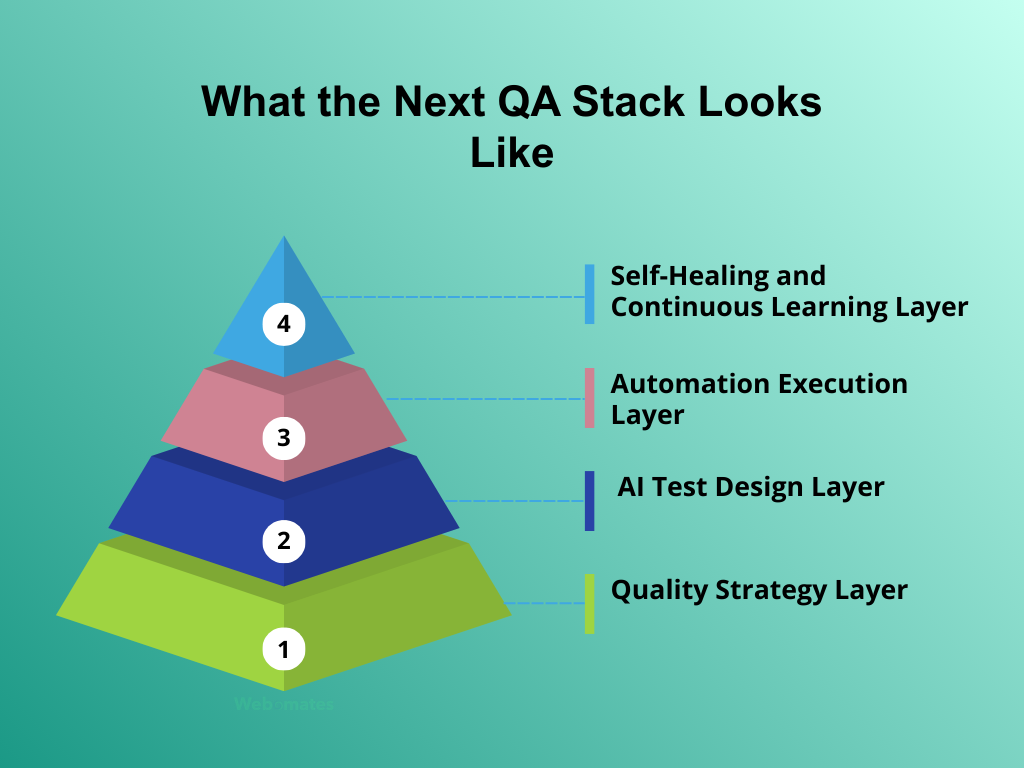
1. Quality Strategy Layer
At the top sits human expertise. Engineers and quality specialists define: risk areas, coverage goals, critical user journeys, and performance expectations. This layer focuses on quality engineering strategy, not script writing.
2. AI Test Design Layer
The second layer is where AI assists in translating strategy into test assets by generating test scenarios, test cases, automation scripts, and coverage recommendations.
3. Automation Execution Layer
Once tests are created, the next layer handles large-scale execution. Automated tests across environments, validation of application workflows, regression testing, and integration with CI/CD pipelines take place.
Because the automation is AI-driven, the system can intelligently decide which tests to run and when, enabling faster feedback for engineering teams.
4. Self-Healing and Continuous Learning Layer
The final layer ensures automation remains stable as the application evolves.
AI-enabled platforms continuously monitor test failures and application changes to update broken locators, adapt tests to UI changes, identify flaky tests, and improve test reliability over time.
This self-healing capability eliminates one of the biggest problems in traditional automation and constant test maintenance whenever the product interface changes.
What This Means for QA Teams
QA teams face growing pressure every day.
Industry data suggests that about 60% of software defects still make it into production, and 80% of customer complaints are linked to these problems. This shows that missed bugs in testing often lead to unhappy users and product risks.
Moving to AI-driven testing does not remove the need for testers. Instead, it changes how and where their skills matter most.
Now, instead of spending time writing and updating scripts, quality engineers can focus on tasks like:
- Designing testing strategies
- Identifying edge cases and risks
- Validating complex user workflows
- Guiding product quality decisions
This change makes QA a more strategic part of software quality engineering.
Companies that adapt to this shift often see faster releases, better automation, quicker bug detection, and more stable products.
Who Benefits Most from AI-Driven Testing?
- Engineering teams running CI/CD pipelines with frequent releases
- SaaS companies with rapidly evolving UI interfaces
- QA teams maintaining large automation suites
- Organizations struggling with flaky test failures and maintenance overhead
This is why many technology leaders now see AI in software testing as a core part of modern engineering infrastructure.
Just as CI/CD transformed deployment pipelines, AI-driven testing is transforming QA pipelines.
Conclusion
As testing becomes more complex, engineering teams look for ways to increase test automation coverage without adding extra work to create and maintain tests.
Webo.ai uses AI to automatically create test strategies, test cases, and automation workflows. Teams can review what the AI generates, approve it, suggest changes, or request additional coverage based on their testing needs.
After the automation is set up, teams can run it across different environments as part of their testing process. Webo.ai’s AI healing features keep tests up to date as the application changes, automatically adjusting when UI elements or workflows are updated.
This helps address a major challenge in automation: the need to constantly update tests after every UI change.
Instead of spending time fixing broken scripts, teams can focus on increasing coverage and checking product quality while the platform keeps automation running smoothly in the background.
Build release confidence by turning QA outputs into decision-ready signals. Start a free trial with Webo.AI and experience how intelligent QA in Agile enables scalable delivery without excessive overhead.
Ready to Transform Your QA Stack with AI?
Transform your QA process with AI-driven test automation that boosts coverage, reduces maintenance, and makes your release process faster and more reliable.
Start Free TrialFAQs
What is AI-driven test automation, and how is it different from traditional automation?
AI-driven test automation uses machine learning and intelligent algorithms to generate, execute, and maintain automated tests with minimal manual intervention. Unlike traditional automation frameworks that rely heavily on static scripts and manual maintenance, AI-driven testing can adapt to UI changes, identify high-risk areas in applications, and optimize test execution. This makes testing faster, more resilient, and better suited for modern CI/CD pipelines where releases happen frequently.
How will AI change the role of QA engineers?
AI will not replace QA engineers; it will shift their role toward test strategy, quality architecture, and risk-based testing design. Instead of spending large amounts of time maintaining brittle scripts or debugging selectors, QA professionals will focus on defining test scenarios, validating edge cases, and ensuring product quality at a strategic level. In the next QA stack, humans design the quality strategy while AI executes and scales the testing process.
What should engineering teams consider before adopting AI testing tools?
Before implementing AI testing tools, engineering teams should evaluate the maturity of their current test automation framework. Key factors include test stability, quality of test data, integration with CI/CD pipelines, and observability of test results. AI performs best when it operates on a structured, reliable automation foundation; it may amplify existing inefficiencies instead of improving quality outcomes.
Why is AI test automation becoming important for modern software teams?
As software delivery cycles accelerate, manual testing and traditional automation approaches struggle to keep pace. AI test automation enables teams to scale test coverage, detect defects earlier, and reduce maintenance overhead. For startups and fast-growing technology companies in particular, AI-powered testing helps maintain product reliability while continuing to ship features rapidly.
What does the future QA stack look like with AI in software testing?
The future QA stack will combine human expertise with AI-powered execution. Engineers and QA professionals will design test strategies, define critical user journeys, and identify quality risks, while AI systems will generate test scripts, maintain automation, and run large-scale regression testing continuously. This model allows teams to improve release confidence, reduce manual effort, and build more resilient testing processes.
