$10B Lesson: Why AI Test Automation Matters

Published on June 17, 2025
One software update… $10 billion in losses.
What went wrong at CrowdStrike? A faulty security software update from CrowdStrike triggered a massive IT outage, causing global disruption—flights cancelled, businesses disrupted, hospitals impacted, and even government agencies affected.
The CrowdStrike incident was a huge wake-up call. Why? Because this wasn't a cyberattack—it was a testing failure.
Why do we still see billion-dollar software failures?
A great question, and one that hits at the heart of modern software complexity. Despite advances in testing, DevOps, and automation, billion-dollar software failures still happen—and here’s why:
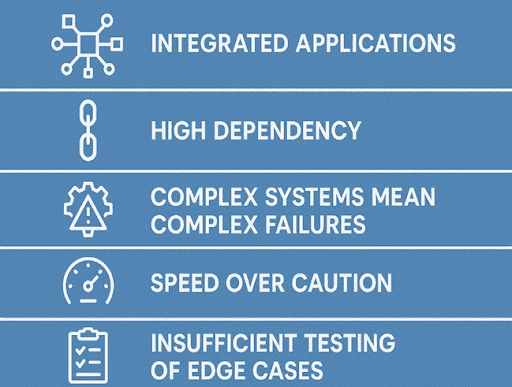
- Integrated applications: Today’s applications are integrated into many enterprise environments, making defects spread fast and wide.
- High Dependency: There is high dependency on critical infrastructure. One defect can create cascading failures.
- Complex Systems mean Complex Failures: Modern software is often built on millions of lines of code, integrated with third-party apps, cloud infrastructure, microservices, or legacy systems. All this makes it difficult to test or predict every failure.
- Speed Over Caution: Organizations prioritize rapid innovation, continuous deployment, and frequent updates. This pressure to release new features or patches fast makes teams take shortcuts or skip comprehensive testing.
- Insufficient Testing of Edge Cases: Missing out on some rare but critical scenarios can cause defects.
The solution? Smarter automation, stronger testing strategies, and quality testing.
Let us look at some of the key pivots that DevOps teams should embrace to strengthen their handling of enterprise security updates.
5 AI-Driven Testing Pivots: Preventing Mission-Critical Outages
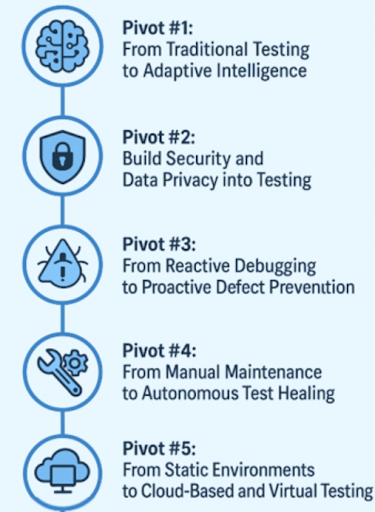
Pivot #1: From Traditional Testing to Adaptive Intelligence
The constant demand for innovation, creativity, quality, and speed makes development and QA teams feel overwhelmed and pressured. Burnout occurs when the team needs to keep updating the test cases to reflect every change as new features are added to the existing functionality.
AI automation testing is the key to elevating precision in testing applications as it adapts to frequent UI or functionality changes. Rather than relying on traditional testing models and manual maintenance that break down in dynamic environments, intelligent systems evolve as the application does, reducing maintenance and boosting resilience.
Pivot #2: Build Security and Data Privacy into Testing
In today’s IoT-connected devices that produce and store vast amounts of data, just validating
the
functionality and testing the performance of the application isn’t enough. It is extremely
important to secure the software’s integrity from any potential threats.
AI-driven
security
testing plays a dual role: it validates the functionality and also detects any
vulnerabilities
proactively by using machine learning to analyze event data and detect threats before they
become critical.
Pivot #3: From Reactive Debugging to Proactive Defect Prevention
Traditional models find bugs after deployment— such defects are 15 times more costly to fix! If the defects are not recorded, mapped, and reported properly, then the time and effort involved in identifying the root cause and rectifying them are much higher.
Regular defect assessment helps manage and fix defects throughout the development cycle. AI tools can help identify defects by testing all possible conditions, data values, and boundary values to cover all logical paths, especially for sensitive and critical code segments.
Pivot #4: From Manual Maintenance to Autonomous Test Healing
Manual maintenance of tests is one of the biggest bottlenecks in software testing today. When applications change due to new features, UI updates, or code fixes, the existing test cases often break due to outdated tests.
Test case maintenance can take up 80% of a team’s time. With AI-driven testing, you can maintain the test automation process effortlessly, allowing for quicker releases.
Pivot #5: From Static Environments to Cloud-Based and Virtual Testing
Static test environments often introduce bottlenecks—issues with test environment setup, configuration, and stability can lead to delays and unreliable test results. By virtualizing test environments and utilizing cloud-based test environments, teams can get stable and scalable environments.
Additionally, testing as a service model leverages cloud infrastructure and advanced AI capabilities, significantly reducing operational expenses while providing flexible testing services.
Lessons for DevOps teams handling enterprise security updates
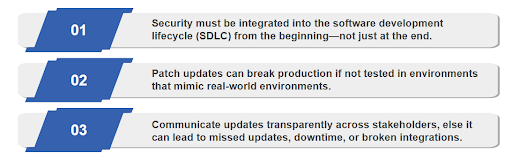
These shifts offer critical guidance for DevOps teams tasked with managing security updates in complex enterprise environments:
How Can Webomates Help
With its AI-driven automation testing platform, Webomates solves key pain points that caused incidents like the CrowdStrike outage.
By using AI and ML algorithms, its self-healing test automation framework dynamically adapts its testing scope to the changes. AiHealing® automatically identifies and resolves false positives in test automation, ensuring the suite stays accurate and up-to-date without manual intervention.
It clubs security testing with regression testing- you can ensure that no functionality was broken while fixing security-related defects. AI-based tools like AI Defect Predictor can predict defects earlier in the development cycle, saving thousands of person-hours lost in defect triaging. A combination of Shift Left Testing and test automation prevents critical defects before they surface, reduces the risks, and thereby accelerates delivery timelines.
Conclusion: Don't Wait for a Crisis
Choosing the right partner for your automation testing journey can significantly impact the speed, quality, and innovation of your software delivery. Keeping in mind how critical the latest technological innovations like Gen AI will be in the testing industry, Webomates has invested in an Intelligent automation testing platform that brings together multiple AI tools and solutions spanning areas such as regression testing, automation, and Gen AI.
We are currently working with several teams to plan their automation journey—enhancing customer experience, reducing cost, and driving innovation in every process, and we would be happy to be your partner as you start your journey too.
Drop us an email at [email protected] or book a free demo to see how we can bring change in your testing process.
