How AI Test Automation Reduces Risk for Early-Stage Startups?

Published on October 06, 2025
Most startups run on tiny teams, tight budgets, and a constant rush to ship. But quality isn’t something you can skip. It’s what earns trust, brings in funding, and keeps customers from leaving.
Poor product quality topples startups. Startups’ Roads to Failure calls it a leading cause. IBM data warns that a production bug can cost up to 100× more than catching it early, an expense many young companies can’t survive.
This is where AI-powered test automation makes a real difference. It takes care of the repetitive stuff, catches problems early, and keeps teams moving fast without losing stability. That means faster shipping, fewer headaches, and greater confidence. For a startup, that can be the difference between running out of runway or taking off.
Challenges Faced by Startups
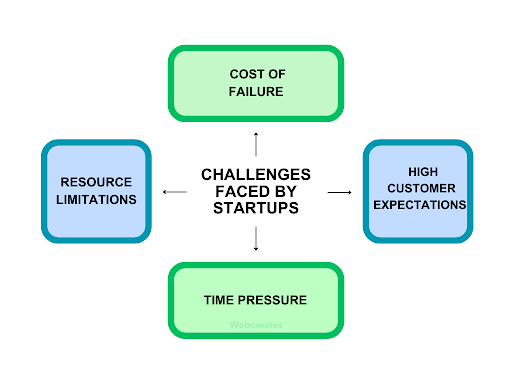
1. Resource limitations
Most early-stage startups operate with small teams and tight budgets. This means every role wears multiple hats, and there’s rarely enough bandwidth to cover everything, especially testing. When resources are stretched thin, quality assurance often takes a back seat, even though it’s one of the most critical factors for survival.
2. Time pressure
The race to ship quickly is real. Startups feel constant pressure to release features fast, whether to attract investors, outpace competitors, or respond to customer feedback. But speed without proper testing can lead to bugs slipping through, resulting in costly rework and credibility damage.
3. High customer expectations
Today’s users don’t cut startups much slack. They expect smooth, reliable experiences from day one, comparing even new apps to polished products from established players. A single glitch can lead to bad reviews, churn, and loss of trust, things a startup can’t easily recover from.
4. Cost of failure
Mistakes hit startups harder than established companies. A major bug or service outage isn’t just an inconvenience; it can derail funding conversations, scare away early adopters, and burn through precious runway. Since fixing bugs late in the cycle is up to 50x more expensive than catching them early, the stakes are extremely high.
How AI Test Automation Can Help Startups
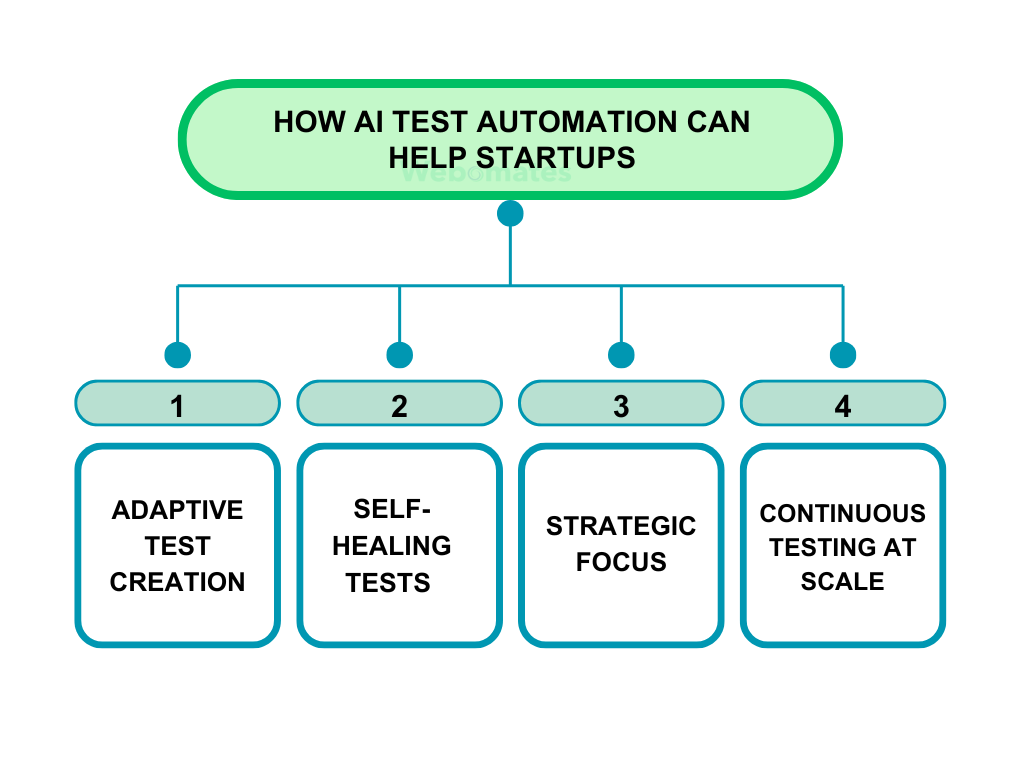
1. Adaptive test creation
With generative AI, tests are created automatically from user flows and code changes. When new features roll out or code shifts, AI generates fresh test cases on the spot, focusing on the paths customers use most. This cuts down manual effort and keeps coverage sharp, even as the product evolves.
2. Self-healing Tests
AI-powered tests adapt automatically when the app changes, like a button move or field rename, so scripts don’t break. This keeps automation reliable across every build and saves teams from constant maintenance.
3. Strategic focus
AI helps teams decide what to test, how to test, and when to test. By analyzing code changes, past defects, and user behavior, it pinpoints the riskiest areas like payments or sign-ups and ensures they’re tested first. This keeps testing focused, efficient, and impactful.
4. Continuous testing at scale
Instead of testing in fixed cycles, AI enables round-the-clock validation. Every code change is tested automatically across devices and environments, removing human bottlenecks and ensuring quality keeps pace with development.
Benefits of using AI in Test Automation
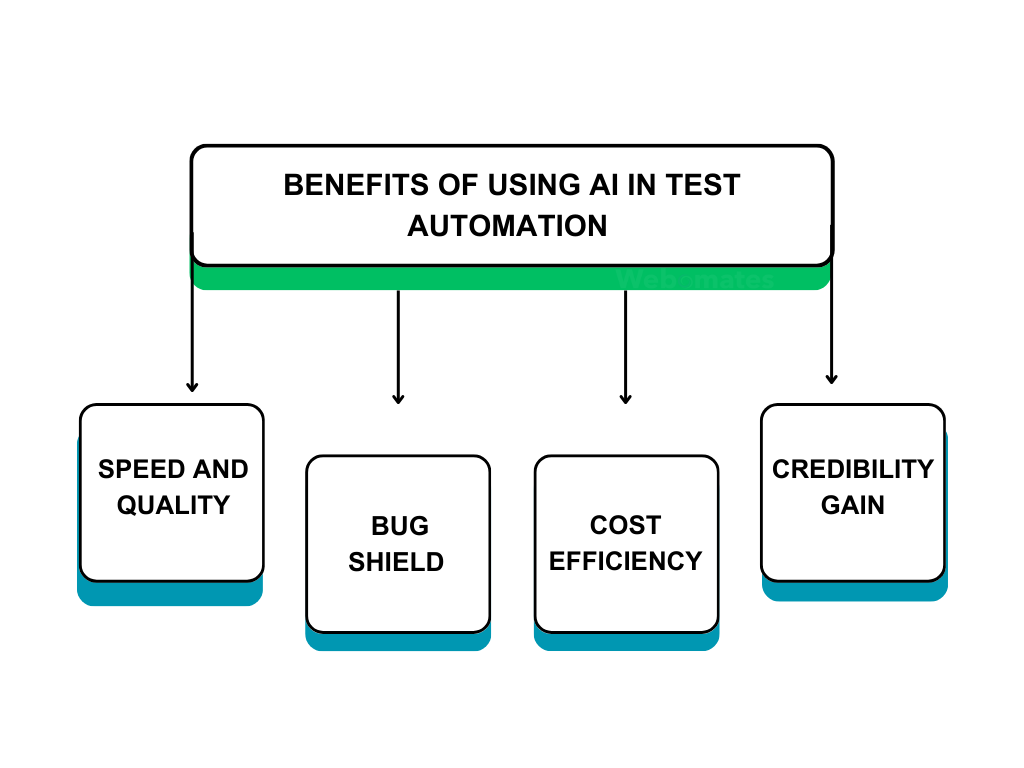
1. Faster release cycles without compromising quality
Startups often face a tough choice between speed and stability. AI test automation breaks this trade-off by running tests continuously and automatically. Teams can ship features faster while still catching issues early, which means they don’t have to slow down to stay safe.
2. Reduces the chance of major bugs slipping into production
By analyzing code changes, user flows, and past defects, AI prioritizes and executes tests in the riskiest areas first. This lowers the odds of a critical bug reaching customers, a mistake that can cost both money and credibility.
3. Lower costs compared to building a big QA team early
Hiring and scaling a QA team is expensive, especially for early-stage startups. AI-powered automation provides the equivalent of extra hands by generating, running, and even maintaining tests at scale. This enables startups to achieve broad coverage without incurring significant increases in headcount or budget.
4. Stronger investor and customer confidence
For investors, a solid QA process signals maturity and reduces perceived risk. For customers, a smooth, reliable product builds trust. By reducing bugs and ensuring consistent quality, AI-backed testing boosts both investor confidence and customer loyalty, the two pillars that determine whether a startup grows or stalls.
Real-World Startup Scenario
Take a health-tech app where patient safety and compliance leave no room for mistakes. In 2020, Babylon Health faced backlash after a software error exposed video consultations to the wrong users. A serious breach of trust and privacy that drew regulatory attention. Even though the issue was fixed within hours, the damage to user confidence was immediate. For a young startup, an incident like this could be devastating. AI-driven test automation helps reduce that risk by running continuous checks, validating sensitive workflows like permissions and data access, and catching errors before they ever reach patients. It’s not just about efficiency, it’s about protecting trust in a space where trust is everything.
From Insight to Action
For startups, AI test automation is nothing but survival. When you’re moving fast, every release is a gamble. Ship with bugs, and you risk losing users, funding, and trust. But with AI in the mix, you can move quickly without cutting corners. It keeps your product solid, your team focused, and your runway safe. And the earlier you adopt it, the easier it becomes to scale with confidence later.
Webo.AI helps early-stage startups reduce release risk with AI-driven test automation—so you can ship fast without cutting corners on quality.
Reduce risk without slowing down. Start a free trial with Webo.AI and keep your product solid, your team focused, and your runway safe.
Ready to Reduce Risk Without Slowing Down?
Early-stage startups need speed and reliability. Webo.AI helps you move fast without cutting corners—keep your product solid, protect user trust, and scale with confidence.
Start Free Trial