Defect Triage: How AI helps in accelerated bug fixing

Published on October 22, 2025
Introduction
It’s release week, and your QA team is flooded with bug tickets. Two critical bugs arrive at the same time; one crashes the app, the other breaks the payment flow. The team struggles to decide which ones should be fixed first and who handles what. Without clear guidance, their decisions will be delayed and deadlines missed.
This is where defect triage helps. It’s the process of sorting, prioritizing, and assigning bugs so that the right issues get fixed by the right people at the right time. Without it, your teams spend long hours in meetings, critical bugs slip through, and releases get delayed.
Traditional triage, however, can’t keep up with the pace of continuous releases and short sprints, because manual reviews are slow, subjective, and leave teams scrambling instead of fixing. AI-powered triage is changing this scenario. Studies on large collections of bug reports from well-known projects like Linux, Apache, and Eclipse show that AI can cut bug fixing time by up to 80.7%, 60.2%, and 23.6% respectively, while keeping developer workloads balanced. These results show how AI brings clarity and consistency, which traditional processes often fail to deliver.
Why Traditional Triage Falls Short?
Traditional triage may look like a simple process: review bugs, rank them, and assign them. But in practice, it quickly becomes a bottleneck. Teams get stuck in long meetings, priorities may shift depending on opinions, and as the number of defects grows, manual sorting can no longer handle it.
Here’s a list of some of the major pain points:
- Time-Consuming: Traditional triage often means spending most of your hours in meetings to discuss every new bug that pops up. By the time you come to a conclusion along with your team, development has already lost precious time that could have gone into fixing issues.
- Lack of Consistency: You need to have data to back your claims. Without that, priority decisions often end up as personal judgements. One sprint might consider a bug marked critical, while the same type of defect in another sprint gets a low priority. This creates inconsistency across releases.
- Hard to Scale: As your application grows, the defect volume can spike up to hundreds or even thousands. When you manually triage defects one by one in these cases, it becomes nearly impossible to scale for enterprise-level projects.
- Delayed feedback loops: When there is a delay in assigning bugs, developers often get defects days later. This forces them to switch context, revisit old code, and spend extra time re-familiarizing themselves with the issue. This slows down your release cycles and lowers team productivity.
How AI Accelerates Defect Triaging
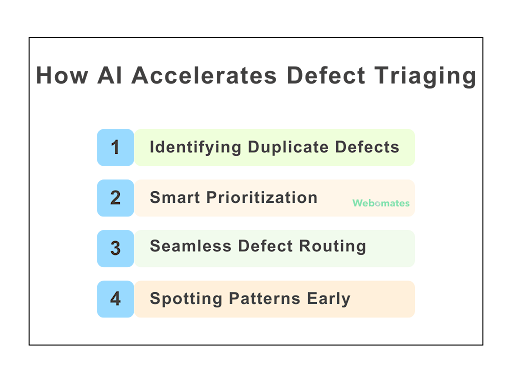
Traditional triage doesn’t have to slow your team down. Instead of spending long hours sorting, discussing, and re-assigning issues, AI makes the process simpler. By learning from data patterns and past history, it delivers faster and more consistent decisions. This is where automated bug triage changes the game for teams. Here’s how you can find it in action:
- Identifying Duplicate Defects: In big projects, the same defect can surface multiple times under different descriptions. AI uses Natural Language Processing (NLP) to scan through reports, detect overlaps, and merge them. This saves the time of your testers and developers from going after the same problem repeatedly.
- Smart Prioritization: Not every bug needs immediate attention. AI evaluates severity, frequency of occurrence, and business impact to suggest the right priority level. This ensures that your critical issues get the top priority, while others are dealt with later. In other words, Bug prioritization AI eliminates the guesswork of deciding what to fix first, making the process clearer and more consistent.
- Seamless Defect Routing: Deciding who should handle a defect can be time-consuming in triage meetings. AI uses defect mappings, historical fixes, code ownership, and skill sets to recommend the best-suited developer. This ensures that your defects are routed to the appropriate person, reducing delays and confusion.
- Spotting Patterns Early: AI doesn’t just focus on the current bugs. By analyzing past defect logs, it can identify recurring patterns and potential root causes. This proactive approach helps prevent repeat issues and keep your releases running smoothly.
Benefits of AI in Defect Triaging
AI doesn’t just speed up the triage process; it also changes the way your teams collaborate. From saving time to balancing workloads, it provides other benefits, too. Here are a few of them:
-
Speed and Efficiency:
AI speeds up triage so that bugs are caught and addressed in the early stages of your cycle. This helps to reduce the risk of critical issues piling up closer to your release stage, when fixing would be more expensive and stressful. -
Smarter Resource Allocation:
AI helps you assign bugs to the appropriate people. When you match the right bug with the right developer, it helps balance the workload well. You need not overload a single developer alone, and the issues land with people best equipped to handle them. This makes the entire process smoother. -
Predictable Release Cycles:
When triage becomes faster and more consistent, you will not face any last-minute surprises. AI identifies and fixes the critical bugs early, and you can plan and stick to your release timelines with more confidence and control.
AI Tools to Supercharge Your Defect Triage
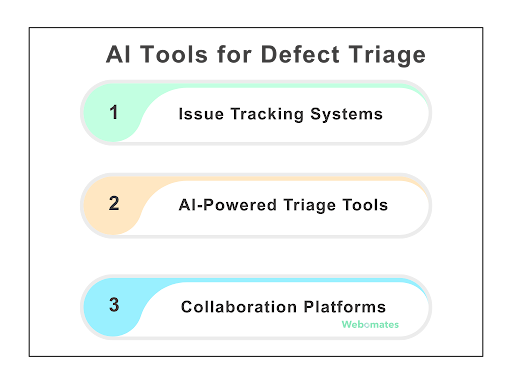
Undoubtedly, AI makes triage smarter, but you get the most out of it when you pair it with the right set of tools. Think of it as building an ecosystem where every process—from reporting to fixing—is covered. Here are a few essentials:
- Issue Tracking Systems: These systems act as your central hub for all bug reports. This ensures that nothing slips through the cracks. A few examples include: Jira, Bugzilla, and Azure DevOps.
- AI-Powered Triage Tools: These tools are not just limited to recording bugs. They detect duplicates, auto-prioritize issues, and identify patterns across sprints, thereby reducing your hours of manual work. Webo.Ai takes this further by combining these AI capabilities with automated testing, making it easier for teams to handle large volumes of defects efficiently.
- Collaboration Platforms: Slack, Microsoft Teams, and similar platforms streamline communication across teams. This makes discussions quicker, defects easier to resolve, and ensures everyone stays aligned on what matters most.
Test Smarter, Test Faster — With Webo.Ai
Defect triage doesn’t have to feel like a never-ending meeting anymore. With AI taking care of sorting, prioritizing, and assigning, your team can now spend less time debating bugs and more time fixing them.
This is where Webo.AI can help. It weaves AI into the testing and triage process, helping your team catch issues early, reduce duplicate reports, and keep release cycles predictable. Instead of poring over spreadsheets or debating priorities for hours, you can get clear insights and actionable assignments that keep work moving forward.
Simply put, triage becomes less about chasing problems and more about solving them. And when your energy goes into fixing instead of sorting, quality naturally takes the lead.
Turn defect triage into a smarter, faster process. Start a free trial with Webo.AI and catch issues early, reduce duplicates, and keep release cycles predictable.
Ready to Accelerate Defect Triage With AI?
Stop debating bugs—start fixing them.
Webo.AI helps your team catch issues early, reduce duplicate reports, and keep release cycles predictable with AI-powered triage.