


How Can AI Testing Add Real Business Value Beyond Bug Fixing?
Published on February 23, 2026

AI testing is widespread. Executive confidence in it is not.
Most organizations already run automated suites at scale. Yet when release time comes, risk is still debated, often days before revenue-impacting launches. That debate has a measurable cost: delayed launches, executive escalation cycles, and engineering time pulled into risk interpretation instead of forward delivery.
That’s when leaders start asking a harder question: Where is the real business value of AI testing? It isn’t higher coverage or faster execution. It’s whether release decisions feel clearer or still dependent on debate and senior judgment.
AI testing beyond bug fixing only matters if it reduces uncertainty at approval time. As systems and teams grow, the constraint isn’t execution. It’s risk visibility.
The Automation Plateau
Many engineering teams reach a stage where automation is technically successful but strategically underleveraged. Suites run reliably, failures are detected quickly, and coverage metrics trend in the right direction.
Yet release friction does not decline at the same rate. What changes at this point is not execution capability, but organizational expectations. As delivery velocity increases and product surfaces expand, leaders no longer ask, “Did the tests pass?” They ask, “What does this mean for exposure?”
When testing output cannot answer that question, the limitation becomes visible in three ways:
- Signal Dilution: Test results accumulate faster than they translate into actionable insight. The volume of validation grows, but its decision value weakens.
- Maintenance Gravity: Engineering effort shifts toward sustaining automation frameworks and resolving test noise rather than evaluating material change.
- Confidence Ceiling: Final approvals continue to require senior arbitration because test results lack business-context clarity.
The result is a widening gap between automation maturity and decision efficiency. As that gap widens, organizations absorb hidden costs: extended approval cycles, duplicated validation effort, and senior engineering time redirected from architecture and roadmap acceleration to release interpretation.
What Business Value from Testing Really Means
AI testing adds business value when it reduces ambiguity in release decisions, shortens approval cycles, and stabilizes delivery commitments.
For senior engineering leaders, that value becomes visible in roadmap predictability, clearer exposure assessment, and fewer escalations at release time.
In practical terms, AI testing business value becomes visible in a few measurable shifts:
- Release Predictability: Roadmaps stabilize because testing output aligns directly with delivery risk and supports exposure assessment under scrutiny.
- Risk Clarity: Leadership can distinguish between routine test noise and material exposure. Attention is focused where it matters, rather than spread across broad uncertainty.
- Decision Velocity: Approval meetings shift from debating risk scenarios to confirming release readiness. Fewer meetings are spent reconciling what the results mean.
- Delivery Stability: Late-stage disruptions decline as testing clarifies impact earlier in the development cycle.
This is where testing shifts from operational validation to strategic leverage. It moves beyond defect detection and begins influencing how reliably the organization can plan, commit, and scale delivery.
For leadership, testing maturity is measured by confidence in commitments, not the size of the test suite.
AI Testing and the New Economics of Quality
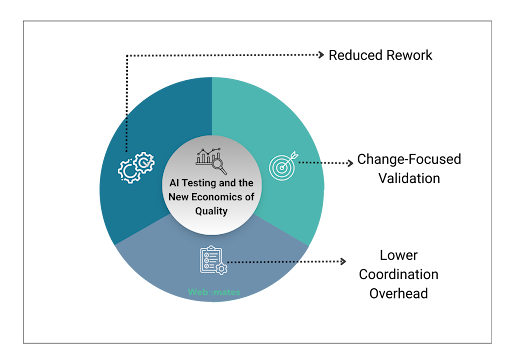
As systems grow more complex, the cost of maintaining confidence rises. Even with automation in place, sustaining quality often requires additional coordination, review, and manual interpretation.
AI-driven testing benefits become more meaningful when that cost structure changes. The advantage is not simply faster execution, but a shift in how validation effort is applied.
Instead of scaling maintenance alongside complexity, AI testing concentrates on material change and potential exposure. That shift produces three measurable effects:
- Reduced Rework: Less time spent repairing tests after routine updates.
- Change-Focused Validation: Greater attention on what actually changed, rather than rechecking stable functionality.
- Lower Coordination Overhead: Fewer cross-team reviews required to establish release readiness.
When maintenance effort declines without adding headcount, the business value of AI testing becomes visible. This is particularly material in US markets where senior engineering talent is expensive, and hiring cycles are slow. AI testing delivers leverage when it expands delivery capacity without expanding team size.
Where Leaders Feel the Difference
The difference becomes most visible under delivery pressure. As release frequency grows and product scope expands, some organizations slow down to protect stability, while others continue scaling without adding layers of review or executive supervision.
Leadership visible changes include:
- Velocity holds steady even as complexity increases
- Teams absorb additional scope and integrations without destabilizing delivery
- Senior engineering leaders focus on architecture, hiring, and strategic bets rather than protecting release cycles
These shifts reflect a delivery organization capable of growth without recurring fragility.
The Boundary of AI
AI testing can accelerate signal extraction across complex systems, surfacing patterns that warrant attention.
What it does not do is define acceptable risk. That determination depends on product strategy, customer commitments, and business priorities.
AI also does not assume accountability. Release ownership, trade-offs, and final responsibility remain with leadership. Without that clarity, even sophisticated insight becomes advisory rather than decisive.
Used effectively, AI testing strengthens governance. It improves the quality of inputs without replacing the authority required to act on them.
Conclusion: Testing as a Delivery Capability
Modern engineering teams are rarely limited by test execution. They are limited by how effectively testing output translates into confident release commitments.
The economic impact of AI testing becomes measurable when validation output reduces that ambiguity as systems grow. At that point, testing stops reporting activity and begins shaping delivery behavior.
Platforms like Webo.ai are designed to connect test execution directly to release criteria, so validation outcomes are mapped to business impact automatically, rather than left for teams to reconcile in meetings and spreadsheets.
If your organization doubled release frequency tomorrow, would confidence scale with it — or would interpretation overhead scale first?
That answer is where AI testing ROI for enterprises becomes real.
Get clarity on release risk without adding overhead. Start a free trial with Webo.AI and connect AI testing to real business decisions.
Ready to Strengthen Release Confidence?
AI-powered testing that reduces decision friction. Webo.AI helps teams move faster with clearer risk visibility and steadier delivery.
Start Free TrialFAQs
How does AI testing add business value from a leadership perspective?
From a leadership standpoint, value shows up when testing reduces friction around decisions. How AI testing adds business value is often visible in quieter ways like fewer escalations, shorter release discussions, and less dependency on senior engineers to interpret results.
When testing output clearly supports go/no-go decisions, leaders spend less time resolving ambiguity and more time planning and executing. That shift is where AI testing starts to matter at a business level.
How can organizations measure the business impact of AI testing without over-relying on metrics?
The business impact of AI testing is rarely captured by coverage numbers alone. A more useful signal is how smoothly releases move through the pipeline. Are decisions faster and delays less frequent? Do escalations happen earlier, or not at all? When testing reduces friction across the release process, its impact becomes visible without requiring another dashboard.
How does AI testing support digital transformation, not just automation?
Digital transformation usually means shipping more often across systems that increasingly depend on each other. As that happens, teams don’t slow down because tests are failing, but because it’s unclear what a change might affect. Reviews pile up, approvals take longer, and releases wait while people double-check what they already tested.
AI testing for digital transformation helps when it reduces that uncertainty. Platforms like webo.ai focus on connecting test signals to release readiness, so teams can see where risk is concentrated and where it is not. That allows organizations to scale delivery without automatically adding more reviews or slowing releases as systems grow.
What does AI testing ROI look like for enterprises?
For large organizations, AI testing ROI for enterprises is often indirect but meaningful. It appears as fewer stalled releases, reduced rework late in the cycle, and less reliance on a small group of experts to approve change.
The strongest returns come when confidence scales without scaling headcount or process. In that sense, AI testing delivers ROI by lowering the hidden costs of hesitation, coordination, and decision friction across teams.
